

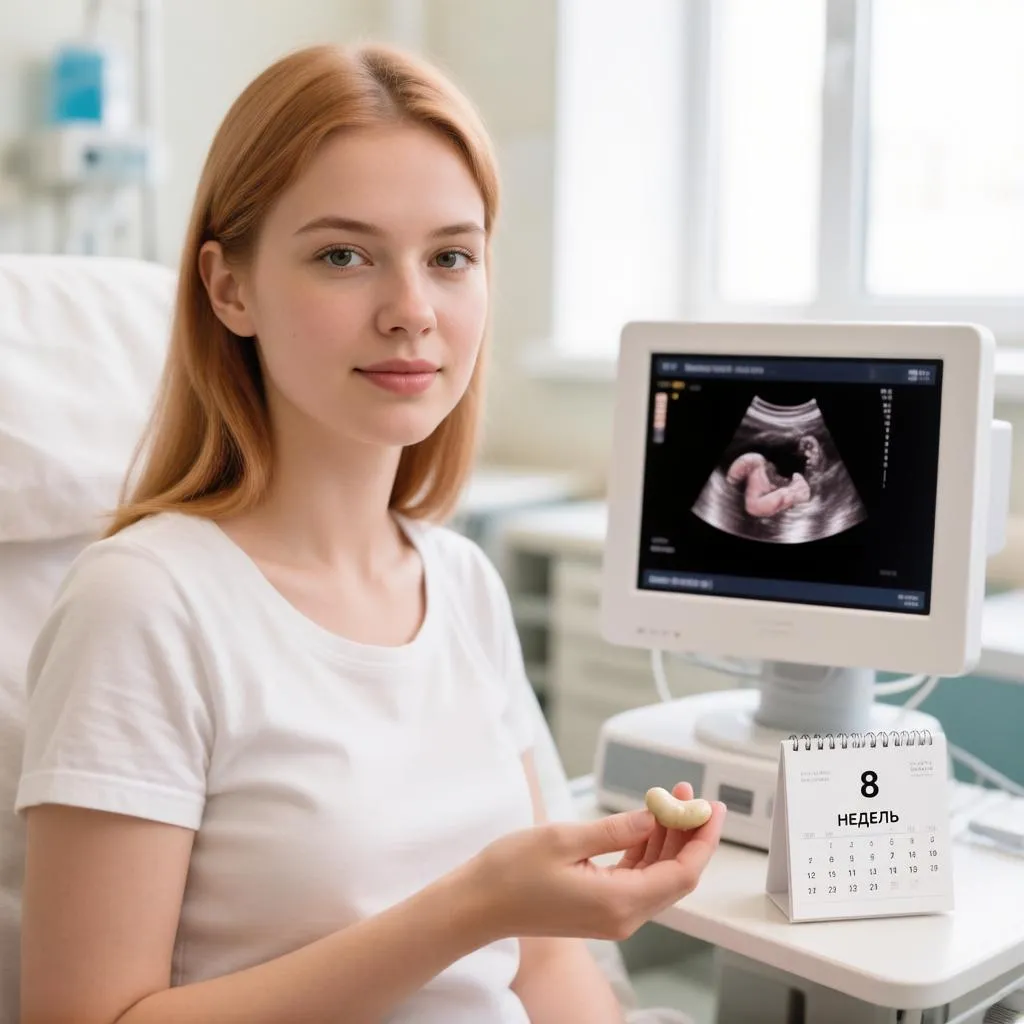
Week eight sits in a peculiar pocket of pregnancy: far enough along that the pregnancy is undeniably real, close enough to the start that the outside world cannot yet see it. The pants still fit, the announcement has probably not happened, and yet inside, one of the most remarkable transformations in human biology is running at full speed. This is the week when the embryo starts looking less like a mystery blob and more like a miniature person in the making — and when many women feel, in their bodies, that something big is underway.
It is also the week when pregnancy symptoms tend to reach their full voice. Nausea, exhaustion, tender breasts and food aversions often peak or intensify around now, which is why the second month feels harder than the first for many people. The good news hiding inside that discomfort is that it coincides with a sprint of development: by the end of this week, the embryo has graduated from a curled shape to something with a beating heart, moving stumps where arms will be, and a brain building connections by the hundred thousand per minute.
The baby at eight weeks: from embryo to almost-fetus
Calling this stage “the embryo” undersells what is happening. At eight weeks, the tiny being measures roughly 1.5 to 1.6 centimeters from crown to rump — about the size of a raspberry or kidney bean — and weighs in at around one gram. Yet inside that tiny frame, the organ-building project that began weeks earlier is accelerating: the heart now beats at roughly 150 to 170 beats per minute, nearly twice an adult’s resting rate, and beats that may have started as early as week six are now clearly regular and strong.
The visual changes this week are dramatic even by embryonic standards. The head, which will dominate the silhouette for weeks to come, is large and curved, with the face beginning to assemble: the upper lip is forming, the nose takes shape as a flattened prominence, and the tiny nostrils become visible. Arms and legs lengthen, and the hands and feet emerge — webbed for now, with fingers and toes beginning to separate over the coming weeks. Inside, the brain is sprouting nerve cells at an astonishing rate, the kidneys are moving into their permanent position, and the intestines are developing so quickly that part of them temporarily protrudes into the umbilical cord. The tail that characterized earlier weeks is shrinking and will be gone entirely soon — a detail that always amuses parents when they first learn of it.
One of the most significant milestones this week: the beginnings of genitalia are forming, though at this stage they look identical for everyone. The visual distinction, when it eventually becomes possible around the second trimester, has nothing to do with what is happening now — right now, both XX and XY embryos are building the same early anatomy. For parents who plan to find out the sex later, week eight is when the plumbing is being laid, and the paint colors will have to wait months.
Pregnancy symptoms at week eight
If week six brought the first whispers of pregnancy symptoms, week eight usually brings the full chorus. This is statistically one of the most symptomatic weeks of the entire first trimester, and understanding why the body is doing what it is doing helps transform the misery from alarming to merely unpleasant. The comparison below shows what most women encounter around this point, and how intense each symptom typically feels.
| Symptom | How common it is | What it feels like |
|---|---|---|
| Nausea, with or without vomiting | Very common, up to 80% | Queasiness that may strike any time of day, often worst around weeks 8–10 |
| Exhaustion | Very common | Overwhelming tiredness, like the deepest jet lag, unrelieved by sleep |
| Breast changes | Very common | Tenderness, fullness, darkening of the areolas, visible veins |
| Food aversions and smell sensitivity | Very common | Foods that were favorites now repel; faint smells seem overwhelming |
| Frequent urination | Common | The kidneys process more fluid, and the uterus presses on the bladder |
| Bloating and constipation | Common | Progesterone slows digestion, leaving the belly feeling oddly full |
| Mood swings | Common | Emotional volatility driven by hormones, fatigue and the enormity of it all |
| Light cramping | Common | Mild twinges as the uterus grows — noticeable but tolerable |
The table tells a story of a body working overtime: every line on it traces back to the hormone surge that is sustaining the pregnancy. The fatigue deserves special mention, because it is often the symptom that surprises women most — it is not tiredness of the ordinary kind, but a bone-deep sleepiness that makes climbing stairs feel like a workout. It is caused partly by progesterone’s sedating effect and partly by the metabolic cost of building a placenta from scratch. The consolation, and it is a real one: the energy returns dramatically, usually somewhere between weeks twelve and fourteen, and many women describe the arrival of the second trimester as having woken from a long, foggy dream.
What the body is doing, even if nothing shows
Outwardly, week eight belongs to the invisible phase. The uterus, now about the size of a grapefruit, has grown from its pre-pregnancy pear shape but still sits low in the pelvis, where nothing can be seen from the outside. Some women notice the very earliest waistband snugness; many notice nothing at all in the mirror, which creates a strange emotional dissonance between how pregnant they feel and how pregnant they look.
Inside, though, the blood volume is quietly expanding — by the end of pregnancy it will have increased by nearly half, and the expansion begins now. This increased blood supply is part of why so many women feel flushed or notice their veins more prominently, especially across the chest and breasts. The skin may also show its first hormonal touches: some notice a faint darkening of the linea nigra, the line running from navel to pubic bone, though the full pigmentation changes come later. All of these changes are proceeding on a schedule set by hormones, not by how anyone feels on a given day.
The first ultrasound and prenatal appointments at this stage
Week eight often coincides with the first prenatal visit or the first ultrasound, depending on the healthcare system and the pregnancy’s specific circumstances. For many, it is also the first time the pregnancy becomes audible or visible in a way that the two pink lines never could. The first ultrasound at this stage typically reveals a beating heart, a small embryo measuring a bit over a centimeter, and — if there are twins — a second flicker that changes everything about the announcement plans.
What the first prenatal appointment covers varies by country and provider, but the first visit usually includes several standard components. Knowing them in advance reduces the appointment-day jitters considerably.
- A full medical history, including menstrual cycles, previous pregnancies, medications and family background
- A physical examination, often including a pelvic exam and a check of blood pressure and weight
- Blood work: complete blood count, blood type and Rh factor, immunity to rubella, and screening for infections
- Urine testing for infection, protein and sugar
- The establishment of a due date, often via ultrasound measurement
- A discussion of prenatal vitamins, particularly folic acid, and any medications currently being taken
Each of these components serves a purpose beyond the paperwork. The blood tests establish baselines that the rest of the pregnancy will be measured against; the dating scan provides the due date that every future milestone hangs from; and the medication review catches anything that needs adjusting before the critical organ-development window closes. Coming out of the first appointment, most women have a schedule for the months ahead — and the abstract idea of “prenatal care” becomes a concrete calendar.
What to do this week: practical steps
Week eight is a working week in pregnancy terms: the habits and choices made now matter, and the appointment calendar begins to fill. The most useful actions are neither dramatic nor complicated, but they set the foundation for the trimesters ahead.
- Take a prenatal vitamin with folic acid daily. If you have not started yet, this is the week to begin — folic acid supports the neural tube development that is completing around now.
- Eat for strategy, not volume. Small, frequent meals work better than three large ones, especially with nausea in the picture; protein and complex carbohydrates stabilize blood sugar and ease queasiness.
- Rethink medications and supplements. Review everything in your medicine cabinet with a doctor or pharmacist — many common medications need pregnancy-specific guidance.
- Cut out alcohol, smoking and excess caffeine. The first is clear-cut; the caffeine guidance typically allows moderate amounts, which most providers define as under 200 mg a day, roughly one 12-ounce coffee.
- Start gentle movement if you are not already. Walking, swimming and prenatal yoga are safe and beneficial; the goal is maintenance, not performance.
- Check your food safety habits. Avoid unpasteurized products, undercooked meat and fish high in mercury; wash produce thoroughly.
- Begin thinking about genetic screening options. Various screening tests are available over the coming weeks; researching them now prepares you for an informed discussion at the next appointment.
The unifying principle across these steps is that week eight is about laying infrastructure rather than making dramatic changes. The folic acid question, the medication review and the food-safety habits matter enormously at exactly this stage because the embryo’s organs are forming in real time. Everything else — the fitness plans, the nursery paint, the name lists — has months of runway ahead.
When symptoms ease or change: what it means
One of the anxiety hotspots of the eighth week is the sudden change in symptoms. A queasy, exhausted week followed by a strangely normal one can feel ominous, especially to anyone who has read the internet’s worst-case scenarios. The reassurance, backed by the reality of how symptoms behave: symptom intensity fluctuates naturally, sometimes from hour to hour, and a quieter day or two is not a signal on its own.
What matters is the overall trajectory, not any single day. Symptoms that fade gradually over a week or two fit the normal pattern of the approaching second trimester. Symptoms that vanish overnight around week eight, especially with no other explanation, are worth mentioning at the next appointment — not because they are likely a problem, but because doctors can easily check hormone levels and, if desired, arrange a scan for reassurance. The rule that applies throughout the first trimester is the same one that applied at week five: judge trends, not moments.
The emotional side of week eight
There is an emotional topography to the second month that deserves its own acknowledgment. For many, this is the week the pregnancy starts to feel simultaneously enormous and secret — real enough to dominate every thought, hidden enough that nobody outside the household knows. The social invisibility of early pregnancy is one of its loneliest features, and the fatigue and nausea compound it: pretending to be a normal, energetic person at work while feeling secretly unwell takes energy nobody sees.
Common feelings this week include anxiety about miscarriage — a fear amplified by the fact that week eight is right in the middle of the highest-risk statistical window — excitement that flickers between moments of doubt, and the strange vertigo of planning a life that is changing faster than it can be announced. All of it is normal. The miscarriage anxiety deserves one factual anchor: by the time a heartbeat has been seen on ultrasound, the odds of loss drop dramatically, and they continue falling with each passing week. Knowledge here genuinely quiets the fear, which is one more argument for attending the appointments that provide it.
A note for partners
Partners experience week eight from the outside, which has its own challenges: the pregnancy is not yet visible, the symptoms are invisible too, and the role can feel uncertain. The most useful contributions at this stage are practical and unglamorous — cooking the meals that suddenly smell intolerable, taking over the grocery runs, handling the 3 a.m. nausea sympathy shifts, and attending the first ultrasound if invited. Asking “how are you feeling today?” — and listening to the real answer — does more for an eighth-week pregnancy than any gift.
The bottom line
Week eight is the engine room of the first trimester: the embryo hits a centimeter and a half, the heart beats steadily, the face assembles, and the brain grows at a pace that will never again be matched. Symptoms, meanwhile, hit their stride — nausea, exhaustion and tenderness peak or build, and the body’s invisibility makes the whole experience feel strangely private. Prenatal care starts in earnest this week: the first appointment, the blood work, the due date, the vitamin routine. The discomfort has a built-in expiration date — the second trimester is roughly a month away — and the development happening inside is worth every queasy minute it costs.